
Simanaitis Says
On cars, old, new and future; science & technology; vintage airplanes, computer flight simulation of them; Sherlockiana; our English language; travel; and other stuff
WHICH WAY IS NORTH? AND WHY ANYWAY? PART 1
JAMES VINCENT REVIEWS JERRY BROTTON’S FOUR POINTS OF THE COMPASS in the London Review of Books, April 15, 2025. Early on, he struck a responsive chord with me: “Every compass needle on the Earth’s surface is moving in response to the 1367-mile-thick ocean of liquid iron and nickel under our feet that generates the planet’s magnetism. This layer is the outer core, churning away under the similarly thick but solid mantle.”
Yes, just as described in “Gedankenexperimante to En Zed” here at SimanaitisSays.
What’s more, James Vincent observes, “as Jerry Brotton writes in his history of the compass, we encounter the paradox of directions that ‘appear to be real and natural’ yet are ‘invented and cultural’ – rooted more in identity, ideology and theology than in geography.” Here, in Parts 1 and 2 today and tomorrow, are tidbits of directionality gleaned from Vincent and Brotton. Some of them border on my familiarity; others are utterly new to me.
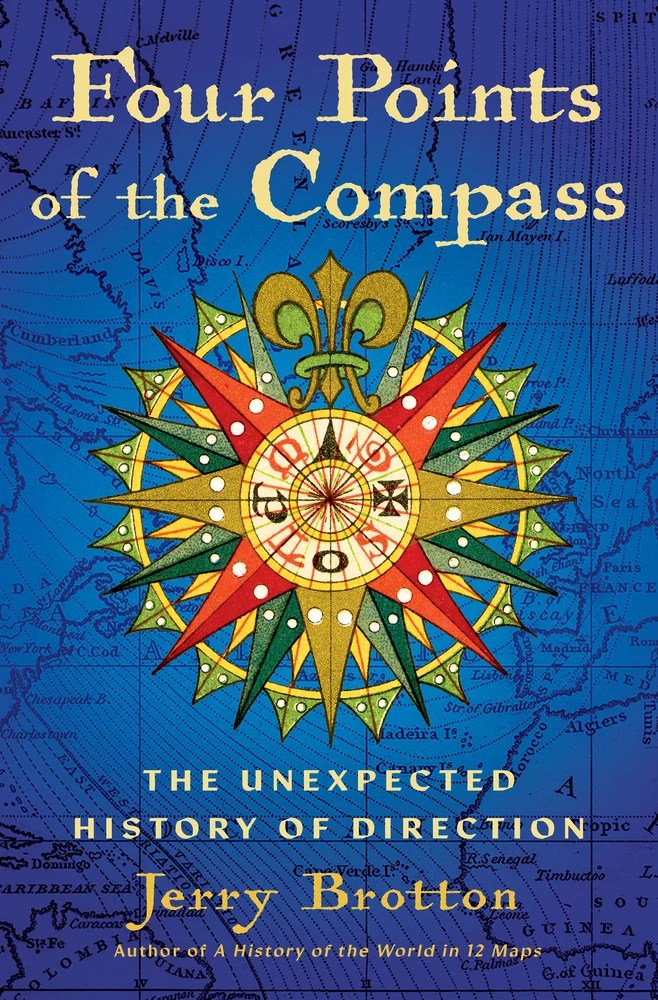
Four Points of the Compass: The Unexpected History of Direction, by Jerry Brotton, Atlantic Monthly Press, 2024.
Jerry Brotton is a Professor of English and History at the University of London. IndieBound notes “he is the author of the New York Times bestselling, award-winning A History of the World in 12 Maps, which has been translated into twenty languages.” Quite the achievement, I’d say, for him and a bevy of translators.
Why Four Directions? Vincent recounts, “The notion of four principal directions is widespread (though not universal) and possibly originates in the egocentric co-ordinates of the human body: front, back, left and right. Brotton suggests that four, as the smallest composite number (a number divisible by a number that is neither one nor itself), has a sense of completeness; a totality reflected in the geometry of the square and the cross, each defined by four points, which perhaps appealed to early mapmakers.”
“Whatever the explanation,” he continues, “the notion of four principal directions is ancient. Naram-Sin, ruler of the Akkadian dynasty in the 23rd century bce, provides the first record by claiming the title ‘King of the Four Corners of the World.’ ”
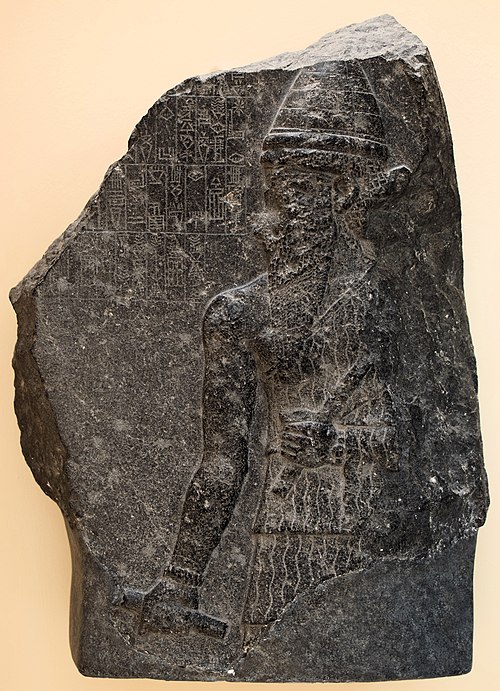
Origins Blowing in the Wind. Vincent cites, “His Akkadian peers also left us the world’s oldest map with four cardinal directions, the Gasur or Nuzi map, though its labels refer not to points but to quadrants, derived from the four different winds that blew into Mesopotamia. There’s the north-eastern ‘mountain’ wind and south-western ‘desert’ wind; the cool and regular north-western wind, and the wet and unpredictable south-eastern ‘demon’ wind.”

East to West: the Diurnal Passage. Vincent cites, “Another directional scheme with a claim to innateness is the Earth’s east-west axis: the route tracking the diurnal passage of the Sun. It has symbolised the journey of birth, death and renewal in numerous ancient cultures.”
Worship the Sun? No, Worship God. However, Vincent cites Brotton in noting that Sun worship was in conflict with the arrival of Judaism and Christianity: ‘… the theology of monotheism meant that the east soon became caught in a shifting language game between condemning the direction of Sun worship as negative, while defining its role in Creation as positive.’ ”
Vincent describes, “The Book of Ezekiel, for example, decries the idolatry of those who worship ‘with their backs towards the temple of the Lord, and their faces towards the east’, yet Genesis locates Eden in the east, and it’s from the east that Adam and Eve must journey after the Fall.”

Tomorrow in Part 2, Vincent continues his review of Brotton’s book; we continue our tidbit gleaning, even from a modern TV series. ds
© Dennis Simanaitis, SimanaitisSays.com, 2025

